Speak. Track. Repeat.
Speaking practice for real life
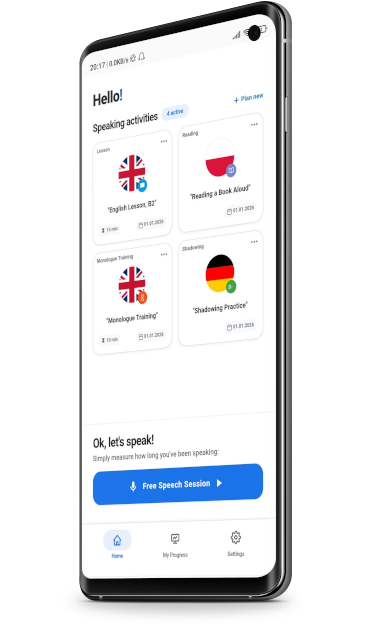
SpeakTime helps you build speaking skills in short, focused sessions. Listen, repeat out loud, and see how many minutes you really spoke. Most learners know the words but rarely say them. SpeakTime gets you speaking every day - and counts every minute you do.
- Real speaking time tracked to the second
- Native speech shadow how people really talk
- All levels A1–C1
Talk more. Learn faster.
Ready to put science into practice?
Join SpeakTime and start building your speaking skills today.
Train your speaking like an athlete
You wouldn't get fit by reading about running.
Speaking works the same way. SpeakTime tracks how many minutes you really speak - so you can see your practice grow every day.
| In Strava | In SpeakTime |
|---|---|
| You go for a run | You do a speaking session |
| Moving time - only when you move | Speaking time - only when you speak |
| Weekly distance shows your progress | Daily/Weekly minutes show your practice |
| Streaks keep you going | Daily practice builds the habit |
THE SCIENCE BEHIND SPEAKTIME
Why speaking practice works
Learning a language isn't just about knowing. It's about training.
Knowing a grammar rule and using it in a fast, real conversation are two different things. Research in memory and language learning shows that saying words out loud, listening carefully and repeating after a good model help you remember more, hear better and build real fluency.
Knowledge vs. skill: what the theory says
According to Skill Acquisition Theory (DeKeyser, 2007), every complex skill - including a language - goes through three stages:
- Knowing about it. You can explain the rule, but you can't use it quickly yet.
- Learning how. You try to use the rule a few times. This stage is surprisingly fast.
- Making it automatic. You use it without thinking. This stage needs a lot of practice - hundreds of repetitions, not a few.
Real conversation happens only at the third stage. People speak too fast for you to "remember the rule" first. Books and teachers are great for the first stage. The step to automatic speaking is mostly your own practice - and that is exactly what SpeakTime is built for.
Why speaking practice works
1. Remember
Saying a word out loud makes it stand out in your memory. Words you speak are easier to recognise later than words you only read.
Learn more
This is called the production effect. In eight experiments, MacLeod et al. (2010) found that people recognised about 76% of words they had read aloud, but only 60% of words they had read silently. Even just moving the lips without sound worked (78% vs 60%).
The effect also works with phrases, sentences and short texts, and it lasts at least a week (Ozubko, Hourihan & MacLeod, 2012). With longer texts the effect is smaller, but still clear.
Your own voice matters too. In Forrin & MacLeod (2018), people remembered words best when they said them aloud, then when they listened to their own recording, then another person's voice — and worst when they read silently.
Keep in mind: the effect comes from contrast. Speaking helps most when you say the important or difficult parts aloud, not every single word. If everything is spoken, nothing stands out.
2. Practice
Speech is a motor skill. Your mouth needs practice, not just your brain.
Learn more
Speaking uses many muscles — in your lips, tongue, throat and breathing. Every language has its own "movements". You can watch how a sound is made many times, but your mouth learns it only by doing it again and again.
Even silent lip movement already helps memory (MacLeod et al., 2010). So the physical action of speaking is a signal to the brain: "this is important".
Like in sport, variety helps. In a small study by Bu et al. (2020), practising a difficult English sound in many different words gave better short-term progress than repeating one word.
In a typical class you mostly listen, so you actually speak the new language only a small part of the time. Speaking practice changes this: almost all of your practice time becomes real speaking.
Keep in mind: the Bu et al. study had only 8 participants and long-term effects were limited — it shows the mechanism, not a final proof.
3. Shadowing
Shadowing - repeating right after a speaker - connects what you hear with what you say and trains your ear for fast, natural speech.
Learn more
In Hamada (2016), 43 university students practised shadowing for nine lessons. All of them got better at hearing individual sounds. Learners with weaker listening skills improved their listening score from 4.84 to 6.20 out of 10. Learners who already listened well did not change (7.78 → 7.72).
So shadowing is especially useful if you know the words but can't follow fast, real speech.
Researchers are also studying shadowing for pronunciation: a systematic review from Oxford (Whitworth, 2025) looked at 44 studies on this topic.
Keep in mind: the 2016 study had no control group, and the "strong" learners were intermediate, not advanced. Hamada himself notes in Teaching EFL Learners Shadowing for Listening (2017) that shadowing for listening does not automatically improve pronunciation. It is mainly a listening trainer.
4. Context
Words are easier to keep when you meet them in meaningful sentences and stories, not in lists.
Learn more
In van den Broek et al. (2022), Dutch speakers learned new Lithuanian words. Later, some of these words appeared in a story. People remembered about 12% of the words that never appeared in the story — and about 44% of the words they met again in the story. That is more than three times better.
Hulme & Rodd (2021) found that word meanings learned from stories stay in memory well over time — and a short self-check right after reading makes the result even stronger.
5. Consistency
Automatic language use needs repeated practice and gradual progress. Short, regular sessions beat rare, long ones.
Learn more
In Skill Acquisition Theory (DeKeyser, 2007), understanding a rule is quick — but making it automatic takes many repetitions over time. Automatic means you react faster, make fewer mistakes and have more attention free for the conversation.
That's why the key is regular practice: a little every day, with the right technique. Practising a mistake also makes it automatic, so it's important to compare yourself with a good model.
6. Real-life content
Dialogues and stories help you learn language the way people actually use it - and you remember them longer.
Learn more
In a classic experiment, Bower & Clark (1969) asked students to learn 12 lists of 10 words. One group connected each list into a story; the other just memorised. Right after each list, both groups remembered almost everything. But at the end, when asked to recall all 120 words, the story group remembered about 93% — and the other group only 13%.
A large analysis of research (Mar et al., 2021) — 78 samples and more than 33,000 people — showed that story texts are remembered and understood better than non-story texts.
Keep in mind: Bower & Clark tested a memory technique with word lists, not language learning itself. The stronger evidence for language comes from studies like van den Broek et al. (2022).
Backed by research
Words read aloud were recognised more often (76% vs 60%) than words read silently.
Better memory for new words met again in a story.
People in a meta-analysis showing stories are remembered better.
Honest science: what speaking practice can and can't do
We believe in speaking practice - and we want you to use it the right way.
It's not about volume.
Speaking everything aloud cancels the memory boost. Speak selectively.
Speaking ≠ understanding
Reading aloud helps you remember, but you need to understand the text first
Shadowing is mainly for listening.
It doesn't automatically make your speech fluent
Effects with texts are moderate
They are real and lasting, but not magic.
Practice makes permanent.
A repeated mistake also becomes automatic - always compare yourself with a good model.
Ready to put science into practice?
Join SpeakTime and start building your speaking skills today.